
1980 – A2D Joystick for Apple II, 1st generation
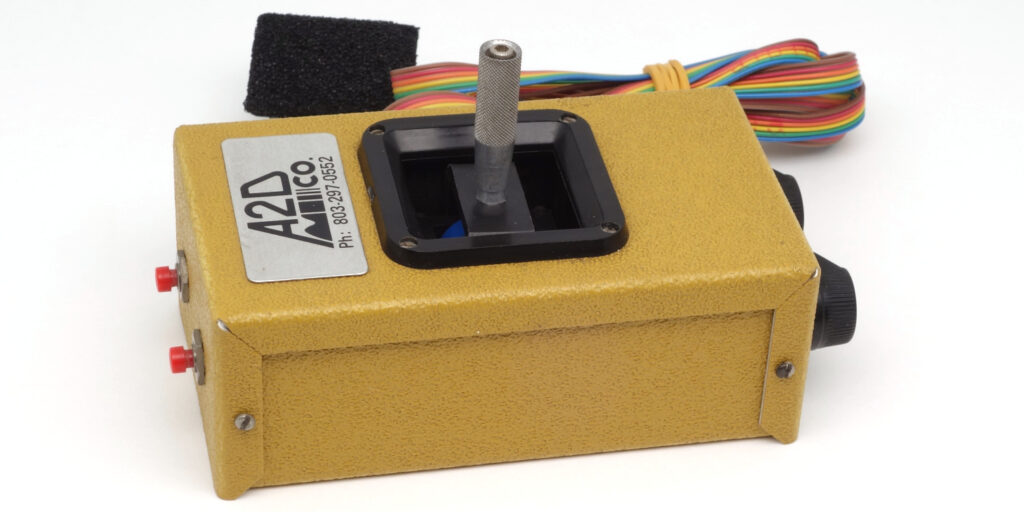
The A2D Joystick, the first-generation analog joystick from the A2D Company for the Apple II computers, was initially developed in the late 1970s and is associated with Jef Raskin, a renowned engineer and interface researcher who played a key role in the creation of the Apple Macintosh.
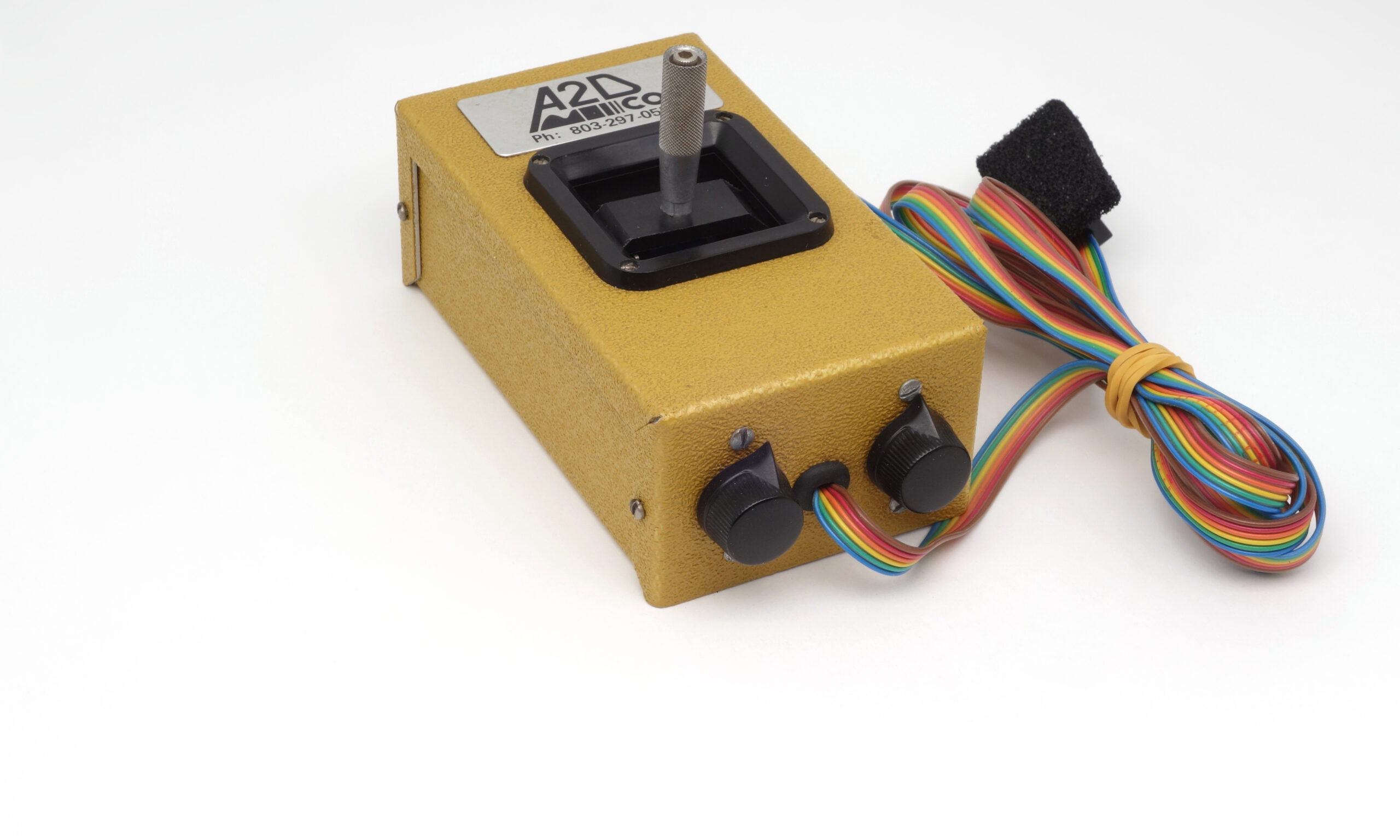
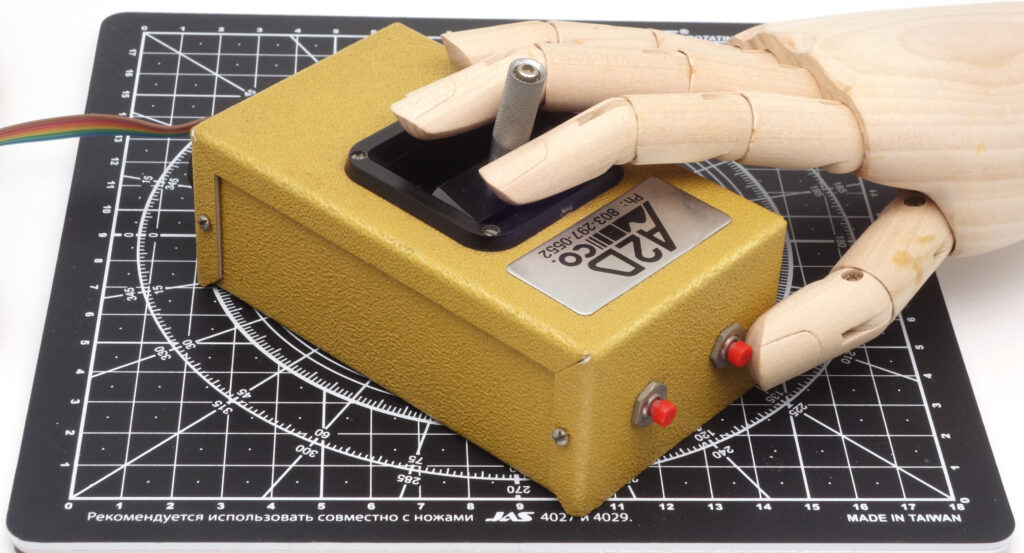
The device borrows the appearance and internal design from aircraft R/C models remote controls of the same time. Following their example, the device is enclosed into a “heavy gold vinyl clad aluminum case (not vac formed)”[1]Van Diver G., Love R. Apple II/III software directory. Vital Information, Inc., 1981. p. PR-21 https://archive.org/details/vanlovesappleiii00gera/page/470/mode/1up?q=a2d+joystick. As seen in the figure below, the “heavy aluminum case” has rectangular shape, and its underside is completely flat, without any elements, including feet. On the top side, there is a plate with the manufacturer’s logo, as well as the stick of the analog joystick unit (trimmers for mechanical adjustment of the central position of the stick are not provided). At one end of the body there are two cut-in red tact buttons. At the other end there are two rotary potentiometer handles that allow user to set zero voltage for each of the axes.
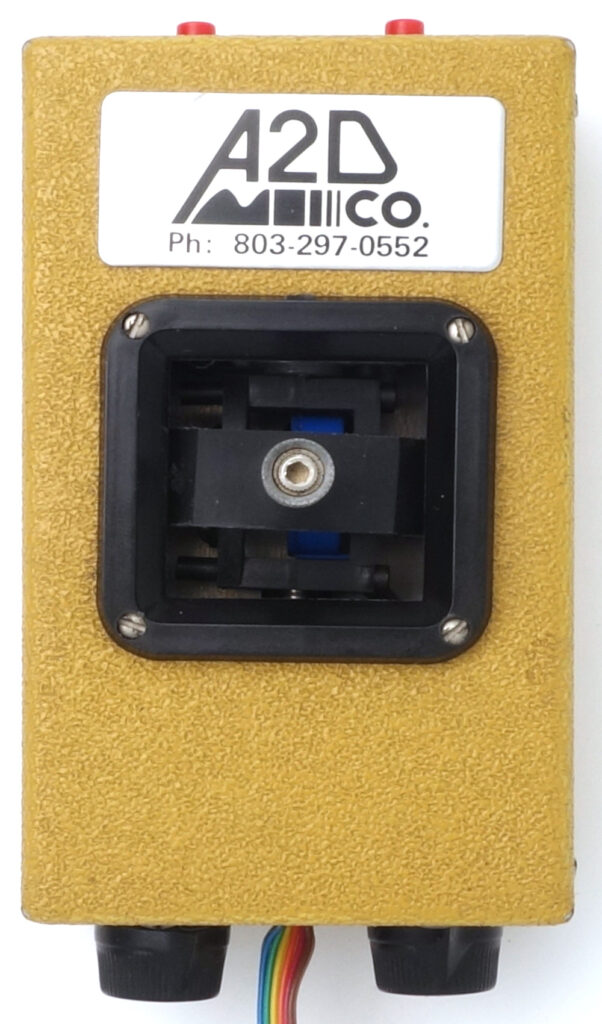
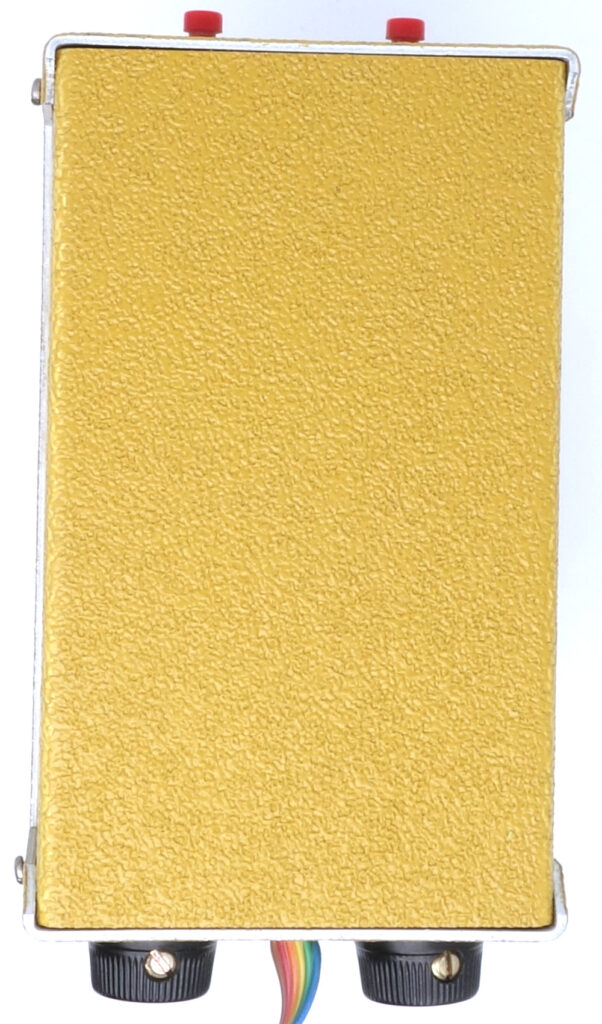
Both externally and internally, the joystick reproduces a sample of the very first joystick for the Apple II, created by Jeff Raskin[2]Jef Raskin’s Apple II Joystick // DigiBarn Devices: Jef Raskin’s Apple II Joystick https://www.digibarn.com/collections/devices/raskin-joystick/index.html, and based on this the A2D joystick can be considered it’s serial adaptation. The only difference which can be noticed is related to the rotary controls: they had smaller size and were randomly cut into the top cover in the Raskin’s prototype, and are reasonably placed to the end of the body in the A2D Company’s exemplar..
Taking into account the date of the first known mention in literature[3]Frederick F.J. Guide to microcomputers / Association for Educational Communications and Technology. AECT-ERIC/Information Resources, Syracuse University, 1980. p. 37 … Continue reading and the fact that “about 500 have been in use for 1 year” stated in another source[4]Van Diver G., Love R. Apple II/III software directory. Vital Information, Inc., 1981. p. PR-21 https://archive.org/details/vanlovesappleiii00gera/page/470/mode/1up?q=a2d+joystick, the device appearance on the marked can be dated back to 1980.
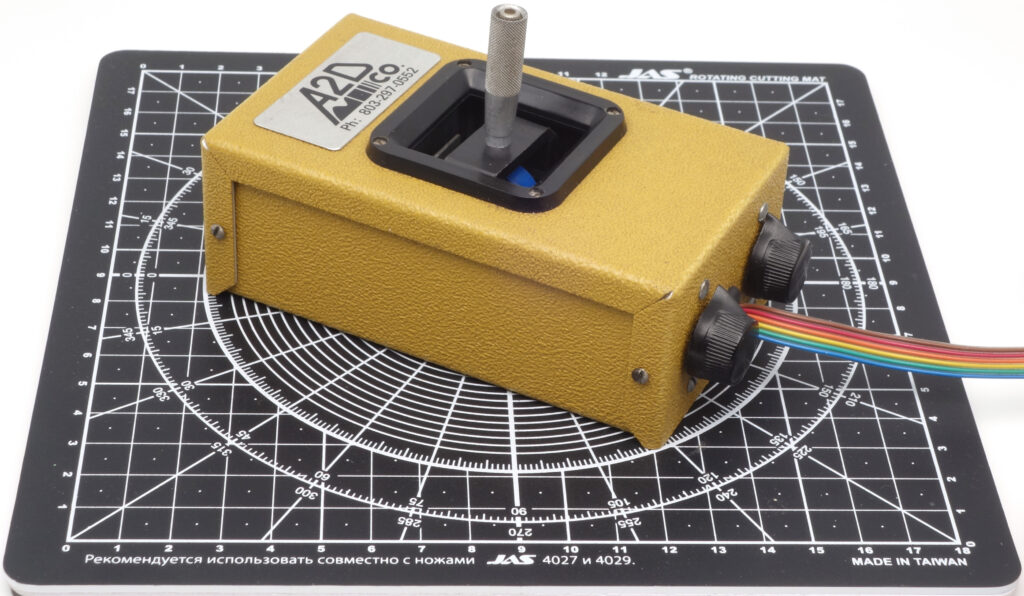
The joystick assembly, including the entire electromechanical unit, was also borrowed from R/C models remote controls. Literature emphasize this relation, mentioning “precision open-gimbaled self-centering stick”[5]Frederick F.J. Guide to microcomputers / Association for Educational Communications and Technology. AECT-ERIC/Information Resources, Syracuse University, 1980. p. 37 … Continue reading, which was “designed for radio control use”[6]A2D Joystick 2001 (advertising) // Creative Computing, Vol.8, No 12, December 1982 – p. 238 https://archive.org/details/CreativeComputing1982-12/page/n231/mode/2up and “results in a lighter feel and more precise movement”[7]A2D Joystick Model 2001 // Creative Computing, Vol.8, No 8, August 1982 – p. 79. https://archive.org/details/creative-computing-august-1982/page/76/mode/2up?q=”a2d+joystick”. In fact, the stick is quite comfortable to control with fingers. The same cannot be said for the miniature buttons without clear tactile feedback – ones that Jef Raskin, not yet a world authority in the world of graphical interfaces, unwisely borrowed from those same R/C remote controls. The buttons don’t produce much load when controlling an airplane model, but the situation is exactly opposite for a computer joystick positioned as “nice hand-held design with two game control push buttons”[8]Van Diver G., Love R. Apple II/III software directory. Vital Information, Inc., 1981. p. PR-21 https://archive.org/details/vanlovesappleiii00gera/page/470/mode/1up?q=a2d+joystick. Using it with computer games and other typical software any long undoubtedly creates a lot of discomfort. Apparently, this flaw was quickly noticed by the manufacturer and fixed in the next model, the A2D Joystick 2001, which received a plastic body with rounded corners and concave keycaps.
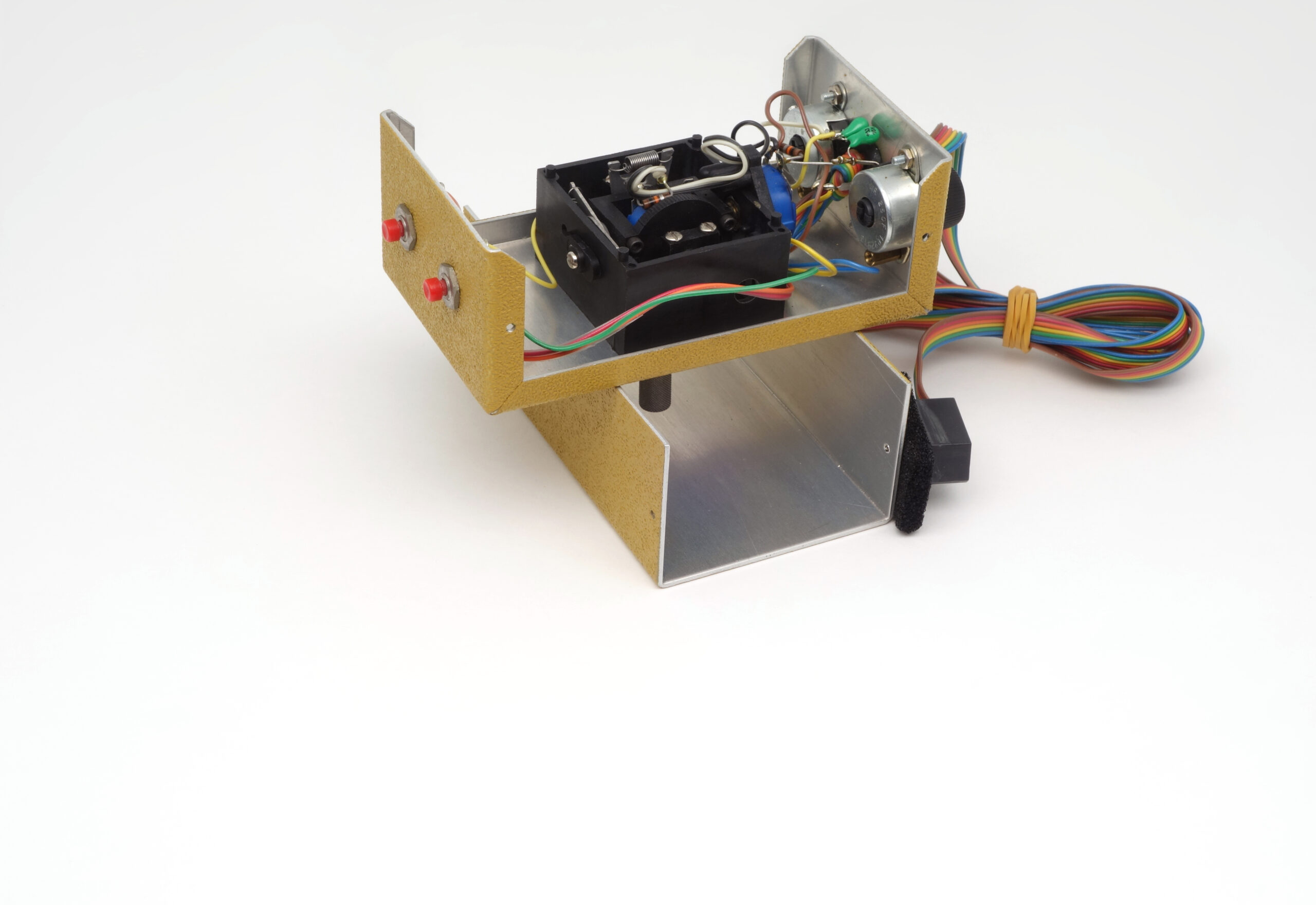
The internal design of the joystick assembly is fairly standard, based on analog potentiometers, converting the deflection of the stick into a change in the electrical resistance. Like in the remote controls of R/C models, the sticks of A2D Joysticks are indeed placed on the metal gimbals actively advertised by the manufacturer.
References
| ↑1, ↑4, ↑8 | Van Diver G., Love R. Apple II/III software directory. Vital Information, Inc., 1981. p. PR-21 https://archive.org/details/vanlovesappleiii00gera/page/470/mode/1up?q=a2d+joystick |
|---|---|
| ↑2 | Jef Raskin’s Apple II Joystick // DigiBarn Devices: Jef Raskin’s Apple II Joystick https://www.digibarn.com/collections/devices/raskin-joystick/index.html |
| ↑3, ↑5 | Frederick F.J. Guide to microcomputers / Association for Educational Communications and Technology. AECT-ERIC/Information Resources, Syracuse University, 1980. p. 37 https://archive.org/details/guidetomicrocomp0000fred/page/37/mode/1up?q=a2d |
| ↑6 | A2D Joystick 2001 (advertising) // Creative Computing, Vol.8, No 12, December 1982 – p. 238 https://archive.org/details/CreativeComputing1982-12/page/n231/mode/2up |
| ↑7 | A2D Joystick Model 2001 // Creative Computing, Vol.8, No 8, August 1982 – p. 79. https://archive.org/details/creative-computing-august-1982/page/76/mode/2up?q=”a2d+joystick” |