
1985 – Xerox Daybreak Mouse

In 1985 Xerox released the official successor of it’s Xerox Star 8010 Information System (the world first office computer with window-based interface from 1981) – the 6085 Professional Computer System workstation, also known as Daybreak. The computer came with the 1.0 version of the ViewPoint GUI (a graphical shell based on the Star software). Among other improvements, these computers received an updated mouse[1]Xerox Daybreak: Wikipedia https://en.wikipedia.org/wiki/Xerox_Daybreak[2]GUI Wonderland #2: A Galaxy of Possibilities – Xerox Star & Daybreak. – The Authopire Compendium, April 16th 2024. … Continue reading.

Exterior
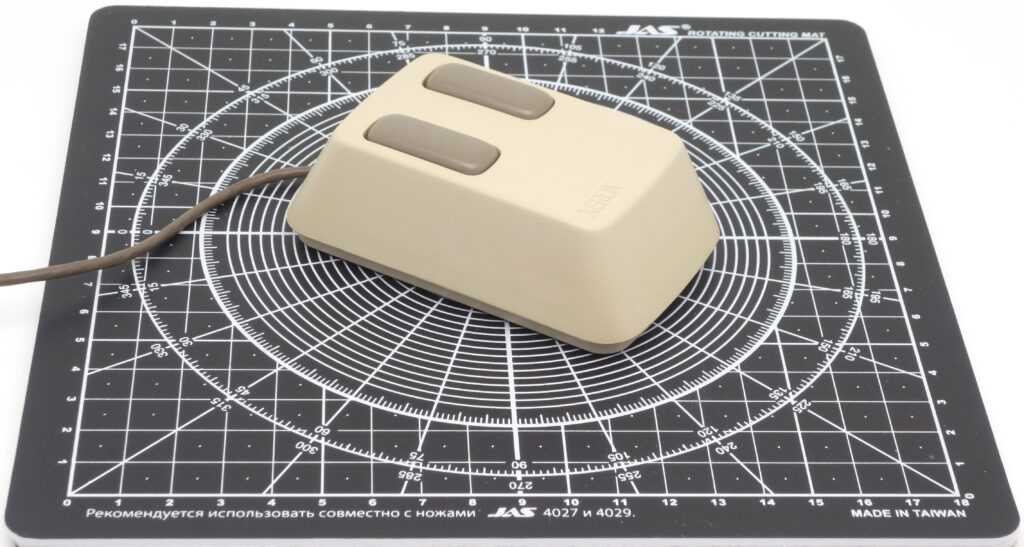
Xerox Daybreak mouse is not very much different from the original optical mouse of Xerox Star[3]Degnan B. Xerox 8010 Star – vintagecomputer.net 11/13/2011 https://vintagecomputer.net/browse_thread.cfm?id=311[4]Alves P. Xerox 6085 workstation from 1985. Retro Microcomputers, Workstations, Servers and Consoles – Welcome! November 27, 2018. … Continue reading. The upper part made of beige plastic is derived from a parallelepiped more or less. The topcase has shape identical to the mouse of Xerox Star: it widens toward the bottom, it’s front and back sides are convex and noticeably inclined, and vertical edges are rounded, substantially reducing the association with a “box”. On the upper side of the case there are two large, oblong buttons made of darker plastic. As with Xerox Star, “SELECT” and “ADJUST” buttons are used to make and adjust a selection[5]Linden T., Harslem E. (editors). Office Systems Technology. A Look into the World of the Xerox 8000 Series Products: Workstations, Services, Ethernet, and Software Development, Xerox, November 1982. … Continue reading.

In distinction of Star mouse, positions of both buttons are moved towards the edges of the body, making it possible to create a variety of this mouse with a third button in between (Xerox Star had no three-button option in intention to make the mouse less confusing, but eventually third button turned out to be useful for engineering and scientific software systems).
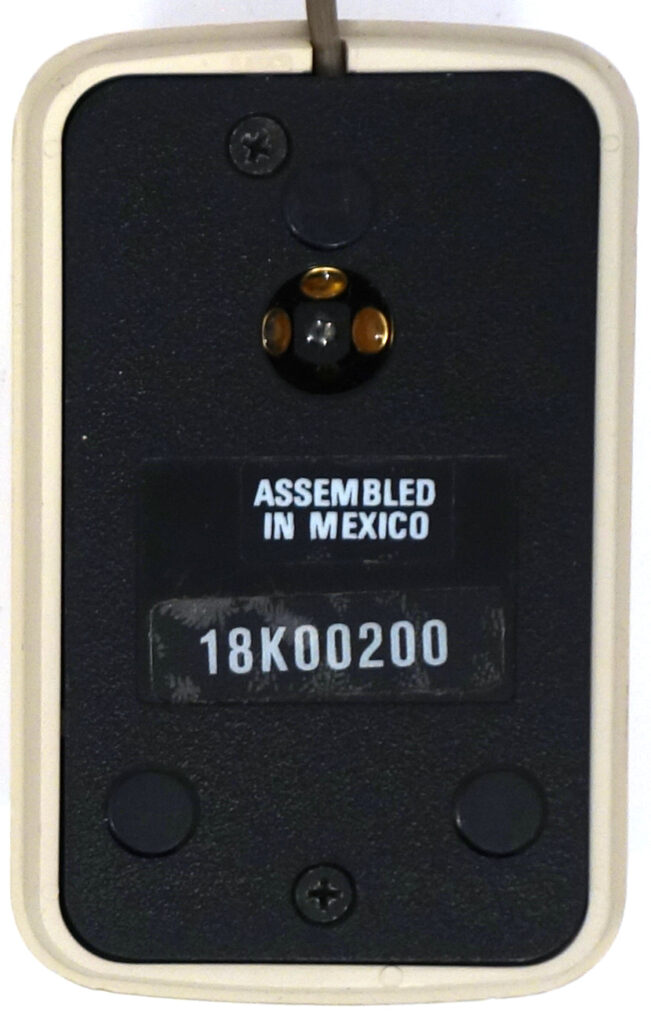
The bottom of the mouse is black, it features 3 plastic feet, the printed mouse model number, and a hole with lenses for the LEDs and the optical sensor. Mouse cable and jack housing are colored to match the buttons. The cable has no mechanical protection of it’s exit from the mouse body.
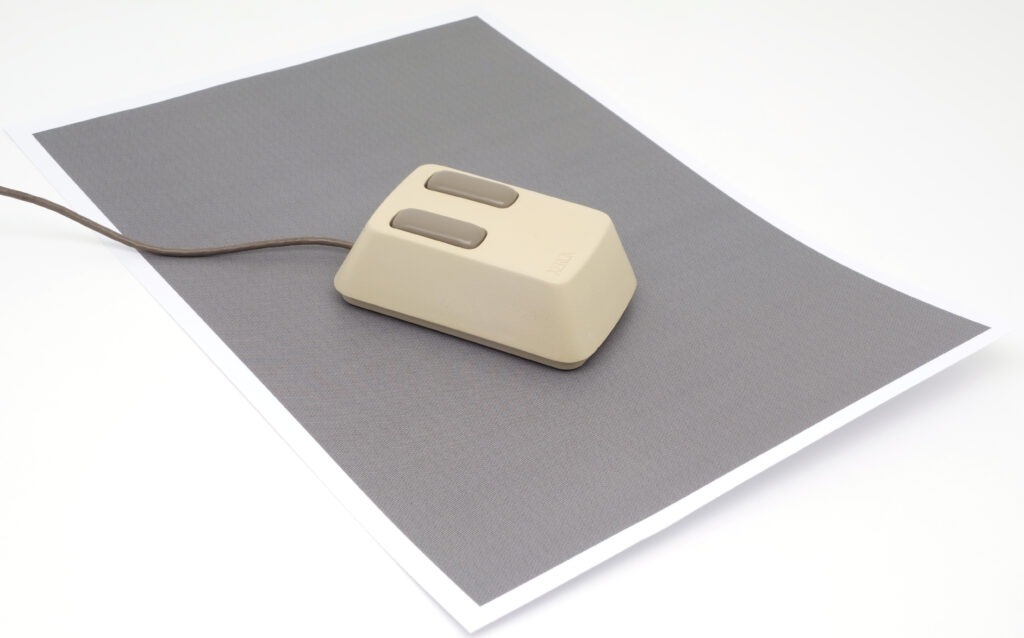
A 4x4 size scanning elements matrix is responsible for reading color inhomogeneities at move, so the mouse required either a pad with a specially designed pattern(an array of light hexagons on a dark field) or any surface with similar alternating light and dark spots, such as denim. The pad is easily reproducible by photocopying, and, more to say, the original Star mouse pad was a paper, sold in packs of 25 sheets[6]Alves P. Xerox 6085 workstation from 1985. Retro Microcomputers, Workstations, Servers and Consoles – Welcome! November 27, 2018. … Continue reading[7]R. F. Lyon The Optical Mouse: Early Biomimetic Embedded Vision / Advances in Embedded Computer Vision, Nov 2014, pp.3-22 … Continue reading. A reconstructed pad can be seen in figure below.

Size
The mouse could have been smaller and lower in size if it had not used the standard Xerox Star mouse body, developed for the uniformly looking mechanical and optical mice. As it is, Xerox Star mouse is rather small than medium, and visually it looks even smaller.
Ergonomics
In terms of ergonomics and appearance, the mouse is minimalist. The user experience of Xerox Star mice (including the Daybreak one) is certainly less affected by the “rectangularity” of the case as it was with the previous Xerox Alto mouse. Convex oblong buttons, located within the reach of the fingers, are still good, and the inclined side of the case closest to the user even provides some comfort for palm – at least, more than a lot of mice of 1980s did (of course, lower body would make it even more comfortable).
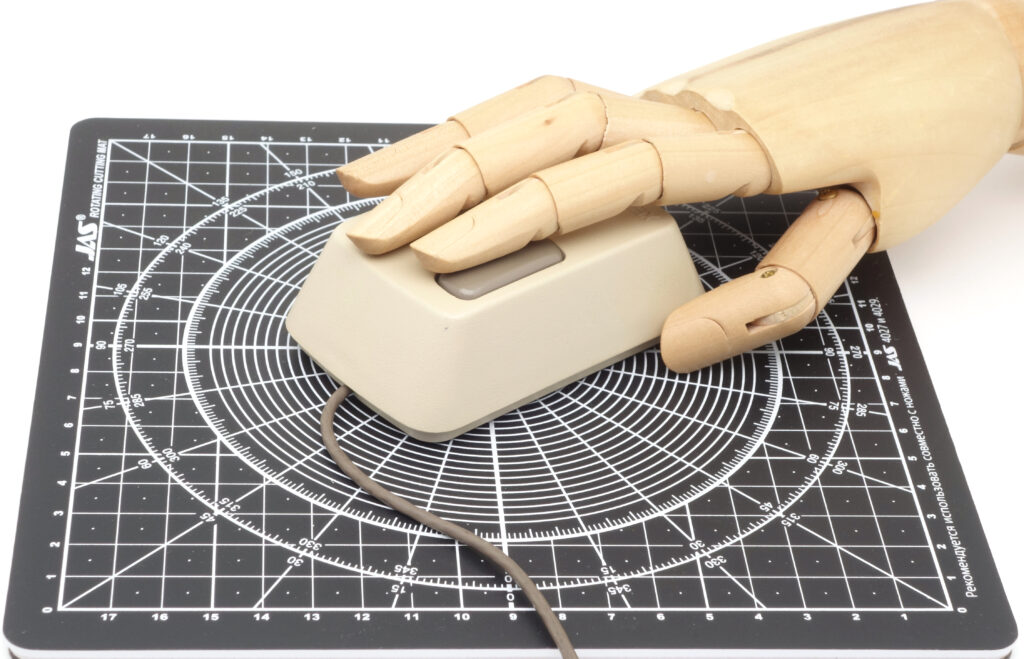
Also, the small body width and its noticeable height, as far as small weight of the device, allow easily carrying the mouse to another part of the mouse pad by holding it with fingers on the sides. This could be handy when the mechanical unit get’s stuck for a while because of some piece of collected derbi – but not very much needed taking into account that the mouse is optical, and the A4 sheet of paper plays as a really large mouse pad.
Connectivity
Like all Xerox mice, Daybreak mouse has a quadrature interface[8]Xerox 6085 PCS Service Manual. October 1988, p. 177 https://www.bitsavers.org/pdf/xerox/6085/service/700P05710_6085_PCS_Service_Manual_Oct88.pdf. Following the original Xerox Star design, the mouse is connected to the computer via the Daybreak keyboard, which has a dedicated mouse socket on its back. But, differently from the previous generations of Xerox computers, instead of D-SUB 15 or 9 pin connector, it features a proprietary miniaturized jack. The socket on the keyboard PCB, though, shows that the difference is more cosmetic than functional: technically it’s still a 9-pin socket with the checkerboard pins order same as D-SUB[9]Xerox 6085 photos. 1186 Keyboard 110K00890 – bitsavers.org https://www.bitsavers.org/pdf/xerox/6085/photos/1186_Keyboard_110K00890/1186_KB_4.JPG[10]Xerox
Daybreak Mouse Converter https://github.com/fiowro/XeroxDaybreakMouseConverter/.

Internal design
Mouse internals are shown below, where you can see the custom chip in a transparent injection-moulded plastic package[11]R. F. Lyon, M. P. Haeberli. Designing and Testing The Optical Mouse // VLSI DESIGN, January/February, 1982. – p. 20–30. https://www.dicklyon.com/tech/OMouse/DesigningTestingOMouse.pdf, which contains the scanning matrix, and also does some initial signal processing. The printed circuit board is raised above the base, and angle-directed LEDs placed under are illuminating the mouse pad. It is interesting to note, that for unification purposes with its 3-button sibling, the Daybreak mouse cable includes wires for all possible buttons, and the third buttons’s wire (green on the photo) is even carefully soldered to the circuit board.

References
| ↑1 | Xerox Daybreak: Wikipedia https://en.wikipedia.org/wiki/Xerox_Daybreak |
|---|---|
| ↑2 | GUI Wonderland #2: A Galaxy of Possibilities – Xerox Star & Daybreak. – The Authopire Compendium, April 16th 2024. https://blisscast.wordpress.com/2024/04/16/xerox-star-daybreak-gui-wonderland-2/ |
| ↑3 | Degnan B. Xerox 8010 Star – vintagecomputer.net 11/13/2011 https://vintagecomputer.net/browse_thread.cfm?id=311 |
| ↑4, ↑6 | Alves P. Xerox 6085 workstation from 1985. Retro Microcomputers, Workstations, Servers and Consoles – Welcome! November 27, 2018. https://www.facebook.com/groups/retrocomputers/posts/2333452826684585/ |
| ↑5 | Linden T., Harslem E. (editors). Office Systems Technology. A Look into the World of the Xerox 8000 Series Products: Workstations, Services, Ethernet, and Software Development, Xerox, November 1982. https://www.bitsavers.org/pdf/xerox/sdd/OSD-R8203_Xerox_Office_Systems_Technology_Nov82.pdf |
| ↑7 | R. F. Lyon The Optical Mouse: Early Biomimetic Embedded Vision / Advances in Embedded Computer Vision, Nov 2014, pp.3-22 https://static.googleusercontent.com/media/research.google.com/ru//pubs/archive/43260.pdf |
| ↑8 | Xerox 6085 PCS Service Manual. October 1988, p. 177 https://www.bitsavers.org/pdf/xerox/6085/service/700P05710_6085_PCS_Service_Manual_Oct88.pdf |
| ↑9 | Xerox 6085 photos. 1186 Keyboard 110K00890 – bitsavers.org https://www.bitsavers.org/pdf/xerox/6085/photos/1186_Keyboard_110K00890/1186_KB_4.JPG |
| ↑10 | Xerox Daybreak Mouse Converter https://github.com/fiowro/XeroxDaybreakMouseConverter/ |
| ↑11 | R. F. Lyon, M. P. Haeberli. Designing and Testing The Optical Mouse // VLSI DESIGN, January/February, 1982. – p. 20–30. https://www.dicklyon.com/tech/OMouse/DesigningTestingOMouse.pdf |